The short answer
In Utah, pallet racks and shelving over 5 ft 9 in tall generally need a building permit. Racks 8 ft and taller generally need structural drawings stamped by a Utah-licensed engineer, with seismic anchorage design. Storage stacked above 12 ft can trigger fire code review for high-piled storage.
Those thresholds come from the model codes Utah adopts and from guidance that cities publish. Your city's building official and fire code official decide what your project needs.
| Height | What generally applies | Where the number comes from |
|---|---|---|
| Rack 5 ft 9 in or shorter | Usually exempt from a building permit when it is movable and not fixed to the building | International Building Code list of work exempt from permit |
| Rack over 5 ft 9 in | Building permit | Salt Lake City racking permit guidance |
| Rack over 5 ft 9 in and under 8 ft | Manufacturer's installation details and specifications, in place of stamped drawings | Salt Lake City racking permit guidance |
| Rack 8 ft or taller | Stamped structural plans and calculations, seismic design, and special inspection of the anchorage | Salt Lake City guidance. The Springville racking checklist also requires an engineer's stamp at 8 ft |
| Top of storage over 12 ft | Fire code review as high-piled combustible storage | International Fire Code Chapter 32, summarized in the ICC high-piled storage overview |
Which codes apply in Utah?
Utah applies the 2024 International Building Code and the 2024 International Fire Code statewide, with state amendments. Both editions took effect on July 1, 2026 under the State Construction Code and the State Fire Code.
Cities enforce those codes and publish their own checklists. Springville's checklist still cites the 2021 codes, so ask which edition your review will use.
When does a rack need a building permit?
A rack generally needs a building permit once it stands over 5 ft 9 in. Salt Lake City's Building Services division states that threshold in its racking guidance.
The number traces to the International Building Code. Its list of work exempt from permit includes movable, nonfixed racks and fixtures no taller than 5 ft 9 in.
A permit exemption does not exempt the rack from the code. Short shelving still follows the manufacturer's instructions and stays clear of exits, sprinklers and electrical panels.
When do racks need stamped engineering and seismic anchorage?
Racks 8 ft and taller generally need structural plans and calculations stamped by a Utah-licensed structural engineer. Salt Lake City and Springville both publish that 8 ft line.
The engineer designs frames, base plates and anchors for earthquake loads as well as product weight. Salt Lake City calls for seismic design under ASCE 7-22.
On site, the anchors have to match the drawings: type, diameter, embedment depth and count per base plate.
What is special inspection?
Special inspection is a check by an independent inspection agency that the rack anchorage was installed the way the stamped drawings specify. Salt Lake City requires a Special Inspection Agreement for racks 8 ft and taller, with storage racks marked as an inspected item.
The agency is named on the agreement before the permit is issued, so line one up early. Under Salt Lake City's guidance, racks shorter than 8 ft do not need special inspection.
When does the fire code get involved?
The fire code generally gets involved when the top of storage passes 12 ft. Above that height, combustible goods on racks or shelves count as high-piled combustible storage under International Fire Code Chapter 32.
Measure to the top of the stored product. A top beam at 9 ft carrying a 4 ft pallet load puts storage at 13 ft.
Fire review looks at what you store, how high and over how much floor area. Those inputs drive sprinkler design, aisle widths, flue spaces and fire department access.
Salt Lake City notes that Chapter 32 does not apply when storage stays at 12 ft or less with no high-hazard commodities. For high-hazard goods such as tires, Group A plastics, flammable liquids and idle pallets, the fire official can apply the rules above 6 ft.
Springville's checklist states that commodities stored 12 ft or higher require sprinklers regardless of the room's area.
Tall racks can hide exit signs and emergency lights, and Salt Lake City requires both in the racking area.
Who can pull the permit?
In Salt Lake City, the permit may be taken out by a licensed general contractor, the owner or the equipment vendor. Other cities set their own applicant rules, so confirm at the permit counter before you sign the purchase order.
Does electrical work on racks need its own permit?
Yes. Salt Lake City requires a separate electrical permit when a rack project includes electrical work, and a Utah-licensed electrician must be named on it.
Aisle lighting, powered conveyors and new circuits for equipment are typical examples. A rack installer does not perform that work.
What does a rack permit submittal contain?
A rack submittal shows where the racks go, how tall they are, what they hold and how the building protects them. These items come from the Salt Lake City and Springville checklists.
- Site and key plan with the address, suite number, hydrants and fire department access.
- Floor plan with proposed and existing racks, aisle widths and the path to each exit.
- Rack elevation from the floor to the top of storage, sprinkler deflectors and roof structure.
- Commodity description: what is stored and how it is packaged.
- Existing fire protection: sprinkler system type and design density, plus fire detection.
- Manufacturer's specifications and installation instructions.
- Stamped structural plans and calculations for racks 8 ft and taller.
- Special Inspection Agreement where the city requires one.
Salt Lake City bases the permit fee on project valuation: the racks, new or used, plus installation labor.
Step by step for a warehouse manager
Start with two measurements and a call to the city.
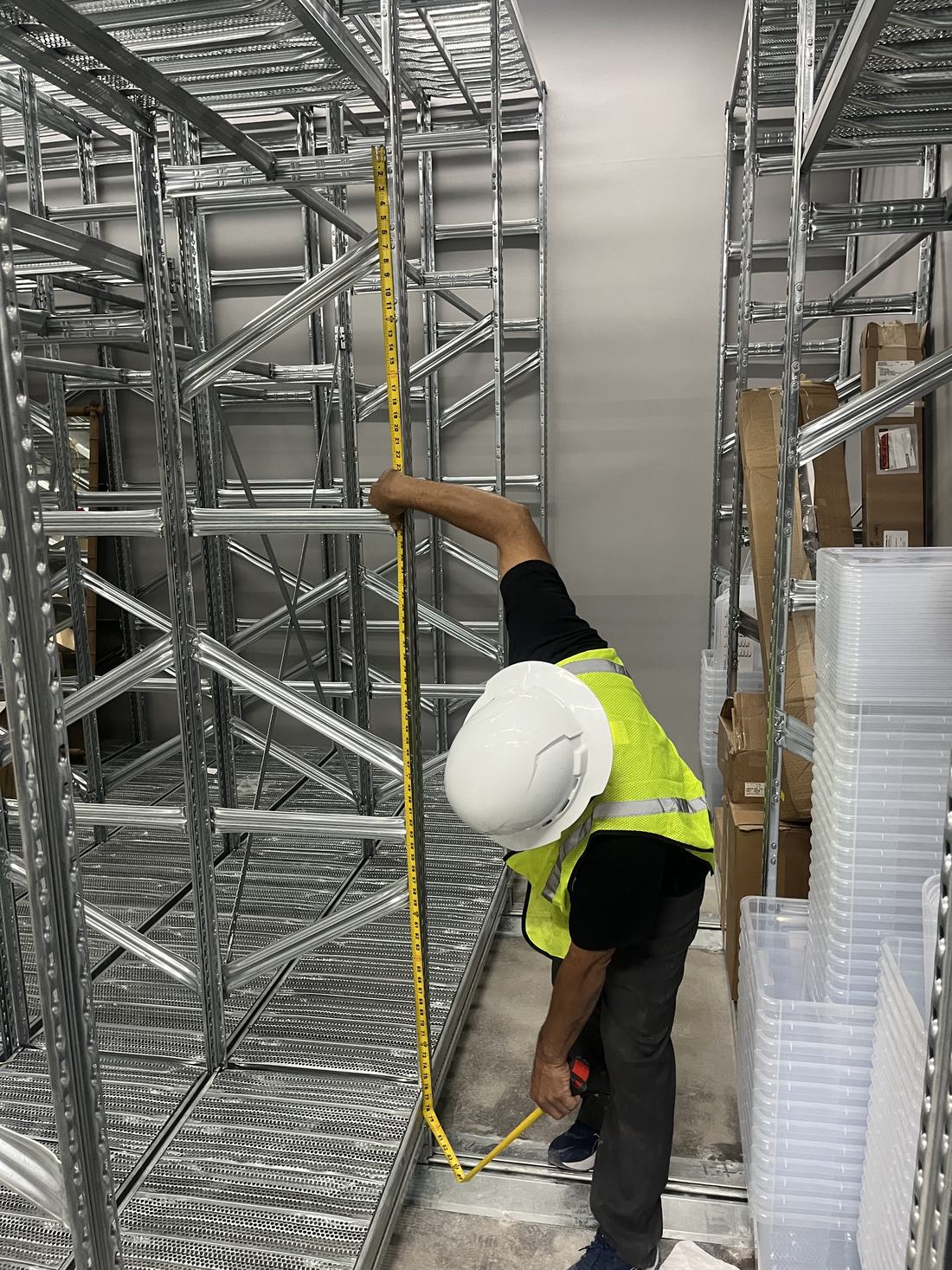
- Measure two heights: the top of the tallest rack and the top of the highest stored load.
- List what you store and how it is packaged. Plastics, aerosols, flammable liquids and tires change the fire review.
- Call the city's building department and fire prevention office. Ask which permits apply, which code edition they use and how long review takes.
- For racks 8 ft and taller, arrange stamped drawings from a Utah-licensed structural engineer.
- Decide who applies, then submit a complete package.
- Hold installation until the permit is issued. Product lead time and plan review can overlap.
- Install to the approved drawings, then book the special inspection and the city's final inspection.
- Mark the approved storage height. Salt Lake City requires it to be permanently marked.
- Ask the city before you move racks, add bays, raise beams or change what you store. Each can change the engineering or the fire review.
Where an installer fits
VASCO installs steel shelving and racking, including Metalsistem systems, and holds Utah B100 #12546496-5501. We identify which thresholds apply to your site and coordinate drawings and submittals with licensed engineers. Electrical work is performed by licensed trade partners.
Scope and photos are on our shelving and racking installation page.
Your building and fire officials decide
Every threshold in this guide is a model-code number or published city guidance, read on November 12, 2026. Local amendments, your commodities and the building's sprinklers can change the answer.
This guide is general information. It is not engineering or legal advice, and it does not replace a permit or a plans examiner's review.