What are drywall finish levels?
Drywall finish levels are an industry scale from Level 0 to Level 5. Each level describes how much taping and joint compound work a wall gets before paint, texture or wallcovering. The Gypsum Association publishes the scale as GA-214, Levels of Finish for Gypsum Panel Products.
Architects name a level in the specification, and contractors price and build to it. Each step up adds coats of compound and sanding, and the wall gets flatter.
The table below is a plain-language summary of the 2021 edition. The published document governs on a project.
| Level | What is done | Where it is used |
|---|---|---|
| Level 0 | Panels are hung. No tape, no compound, no corner bead. | Temporary construction, or walls whose final finish is undecided |
| Level 1 | Tape is set in joint compound at joints and inside corners. Tool marks and ridges are acceptable. Fastener heads can stay uncovered. | Above ceilings, in plenums and other concealed spaces, and at smoke barrier joints |
| Level 2 | Tape is embedded and wiped down, which leaves a thin coat over joints and corners. Fasteners and corner bead get one coat. Tool marks are acceptable. | Tile substrate, garages, storage and warehouse areas where appearance is not a concern |
| Level 3 | Taped joints and corners get one more coat. Fasteners and corner bead get two coats in total. The surface is smooth, with no tool marks. | Walls that will receive a medium or heavy texture, or heavy commercial wallcovering |
| Level 4 | Flat joints get two coats over the tape and inside corners get one. Fasteners and corner bead get three. The surface is smooth, with no tool marks. | Smooth walls in flat paint, light texture or wallcovering. The usual choice for office walls |
| Level 5 | Everything in Level 4, plus a thin skim coat of compound over the whole surface. | Gloss and semi-gloss paint, dark or deep colors, and walls under strong side light |
Where does each level belong in an office?
Match the level to the final finish and to how light hits the wall. Concealed surfaces get the low levels, and smooth painted walls get Level 4 or Level 5.
- Above the ceiling grid and inside chases: Level 1. The joints are taped and nobody sees the surface.
- Storage, mechanical and electrical rooms, and warehouse walls: Level 2.
- Gypsum panels behind tile: Level 2.
- Walls getting knockdown or another medium to heavy texture: Level 3.
- Offices, corridors and conference rooms in flat paint or light texture: Level 4.
- Lobbies, glass-front rooms and any wall in gloss, semi-gloss or a deep color: Level 5.
GA-214 pairs Level 4 with flat paint and cautions against sheen and dark colors at that level. Many offices still use a low-sheen eggshell over Level 4 for washability.
That works on walls without strong side light. A sample wall settles the question before the whole floor is painted.
What is critical lighting?
Critical lighting is strong light that strikes a wall from the side and exaggerates every joint and ridge. GA-214 names windows and surface-mounted fixtures as the usual sources, and it lists critical lighting as a Level 5 condition.
Offices have plenty of it: floor-to-ceiling glass, wall washers and long corridors with a window at the end. Check those walls at the hour the sun rakes across them.
Why do patches flash?
A patch flashes when the repaired spot reflects light differently from the wall around it. The color matches, yet the patch reads as a dull or shiny shape.
Bare joint compound is more porous than a painted wall, so finish paint dries with a different sheen over it. A sanded patch is also smoother than the roller texture beside it, and a thick edge leaves a ridge.
GA-214 describes a related effect at joints as photographing, where finished joints shadow through the paint. It notes that sheen and dark colors highlight differences in the surface.
How do primer and skim coats prevent flashing?
Primer evens out porosity and a skim coat evens out texture. Together they give the finish paint one uniform surface to dry on.
- Feather the compound well past the repair so the edge fades out with no ridge.
- Sand, then check the patch with a work light held flat to the wall.
- Prime every patch before finish paint. GA-214 recommends a primer over the prepared surface before decoration.
- Match the roller nap so the patch carries the same stipple as the wall.
- Paint the wall corner to corner where sheen or side light would show a spot touch-up.
- Skim coat the whole wall when patches are many or the lighting is critical. That is the Level 5 step.
Which wall textures are common in Utah?
Utah commercial interiors generally carry one of four finishes: smooth wall, orange peel, knockdown or a hand-troweled texture. Newer office space is mostly smooth. Older suites and back-of-house areas are more often textured.
| Texture | What it looks like | Level underneath | Repair note |
|---|---|---|---|
| Smooth | No texture, paint only | Level 4 or Level 5 | The least forgiving. Patches need wide feathering, primer and often a full-wall repaint. |
| Orange peel | Fine sprayed spatter, like citrus skin | Level 4 under a light spray, Level 3 under a heavier one | Match the spatter size on a test board before spraying the wall. |
| Knockdown | Sprayed spatter flattened with a knife into flat islands | Level 3 | Spatter size and knockdown timing both have to match. |
| Skip trowel and other hand textures | Irregular pattern applied by hand | Level 3 | The hardest to match. Blend a larger area than the patch. |
Texture hides joints, which is why textured walls can sit on Level 3. It also makes repairs harder, because the patch has to match the pattern before paint can hide it.
Which level should you ask for?
Ask for Level 4 on office walls in flat or low-sheen paint. Ask for Level 5 on any wall with gloss, a deep color or strong side light.
- Write the level into the scope, room by room if it varies, so quotes compare.
- For repairs, ask that each patch match the level and texture around it and be primed before paint.
- Ask for a sample wall before committing a large Level 5 area or a deep color.
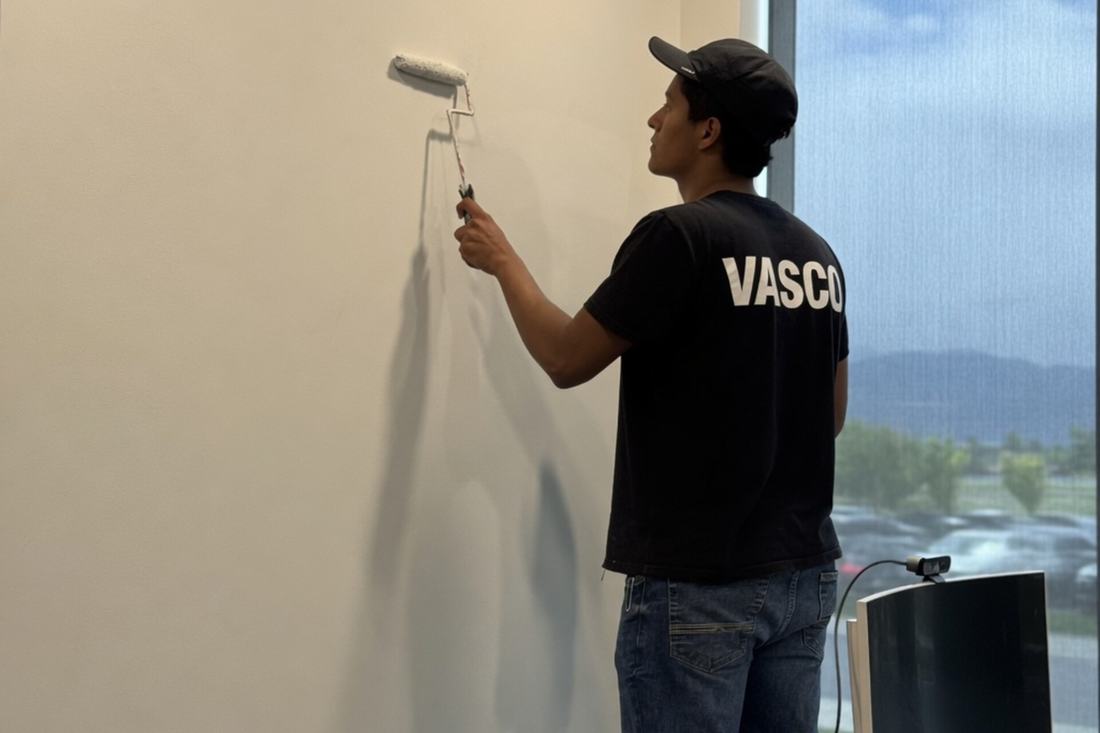
VASCO finishes drywall repairs up to Level 4 and Level 5 under Utah B100 #12546496-5501, and matches existing texture. The same crew primes and paints, so the patch and the finish coat have one owner.
Repair scope and photos are on our commercial drywall repair page.